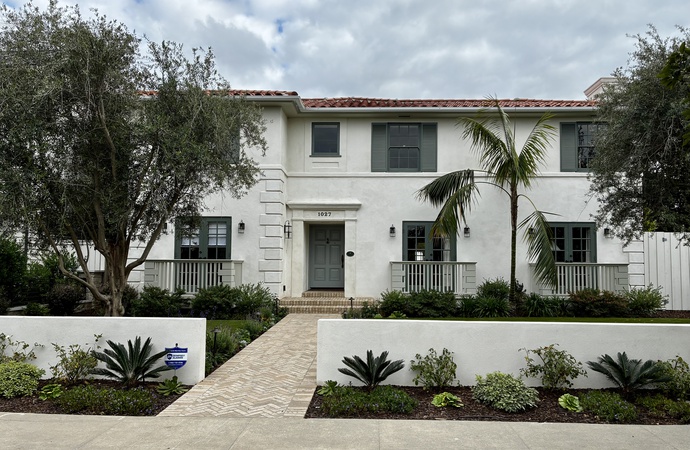
Rooted in memory and responsibility, this Coronado home’s restoration is as much a story of family as it is of historic preservation. For the homeowner, the house was never just a property she acquired; it was the place where she and her brother grew up. Her parents purchased the home in 1983, and after they passed, she took it on with her husband, determined to honor both the house’s architectural legacy and her parents’ deep respect for its history.
The homeowner’s father had long understood the significance of the home. He researched its architect, studied comparable houses, and made sure the home was added to the City’s Historic Register as part of his own legacy. While the current homeowners always appreciated the “good bones” of the house, it was her father’s reverence for its history that truly set the tone. Beyond renovation, this was stewardship.
By the time the current homeowner inherited the home, it had been busy and full for decades. While it was well-loved, it needed extensive work. Repairs ranged from cosmetic to structural, and nearly every functional system required attention. The guiding goal became clear early on: preserve and enhance the features that defined the home’s historic character. One signature archway in the living room, for example, was carefully duplicated throughout the house to maintain architectural continuity.
To bring that vision to life, the homeowners assembled a trusted team after an extensive interview and bidding process. Architect Christian Rice and his team, builder Jack Wonders of Wonders Construction, interior designer Kellie McCormick of McCormick & Wright, and Kevin Graham of MK Graham Landscape Construction, Inc., leading the landscape efforts, emerged as the perfect partners. Together, they shared a commitment to quality and longevity; never cutting corners, even when cost, time, and logistics became overwhelming. During much of the restoration, the homeowners were living in Los Angeles and had just adopted two baby girls. Balance was the greatest challenge, but compromise on quality was never an option. The intention was to ensure the home would last for another generation.
Many of the most meaningful details are subtle. The staircase remains exactly as the homeowner remembers from childhood, down to the moulding. When one piece was found missing, Jack restored it exactly as it was originally, the missing piece now a feature, not a problem to be fixed. The original hardwood stairs were preserved, and a custom dye was created so the old flooring would perfectly match the new. As many original windows as possible, each with different shapes and sizes, were meticulously restored. Original doorknobs were saved, and replacements were chosen specifically to patina over time.
Modern functionality was introduced thoughtfully, one room and one appliance at a time. While the kitchen and dining room were opened up for contemporary living, the sunken living room, rich with memory, was left intact, distinguished by hardwood floors laid in two different directions. The kitchen design leaned timeless rather than trendy, ensuring it would feel appropriate for decades to come.
The living room remains one of the homeowner’s favorite spaces: largely original, with its archways, built-in bookshelves, and a fireplace updated with hand-painted tiles. Her former bedroom now functions as her home office, complete with original bookshelves recreated and updated. Even the century-old mailbox, impractical as it may be, continues to create new memories, now for a daughter who is just as obsessed with checking the mail as she once was.
The restoration came with surprises—hidden plumbing and roofing issues, and a year-long ordeal upgrading gas and electrical service—but it also revealed treasures, like original hardwood floors long hidden beneath carpet and an original, hand-written open house flyer listing early visitors. Some of the restoration plans even drew directly from ideas Lindsay’s father had developed with architect Lorton Mitchell but never realized.
Today, the home is recognized by neighbors who regularly stop by, grateful it wasn’t torn down, often remarking that the modernization somehow made it look more like its original self. For the current homeowners, being stewards of this piece of Coronado’s history is both a gift and a responsibility—one they hope to pass on to their children.
Their advice to others considering restoration over demolition is simple: if you can do it, do it. Hold tight to your “why.” The challenges are inevitable, but with a clear vision and respect for history, the reward is a home with character that connects generations past, present, and future.