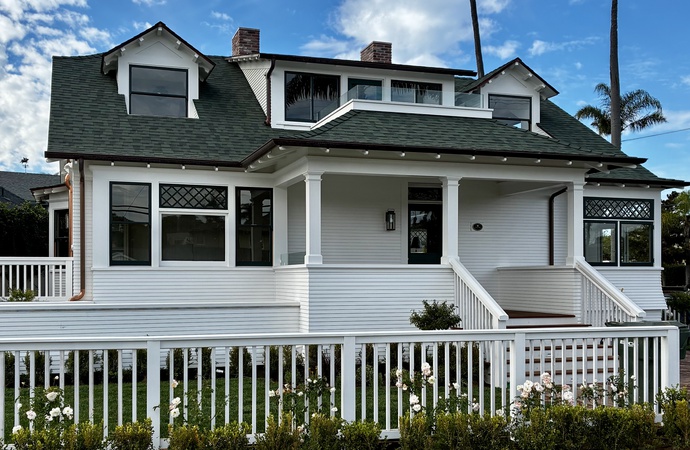
On a prominent corner lot overlooking one of Coronado’s longest view corridors, a historic home has been thoughtfully restored. The house first stood out not just for its location, but for its pedigree. Built in 1904 by Charles William Houts, the prolific builder responsible for over 600 homes in San Diego and Coronado, this property was originally one of three side-by-side rental residences. Its distinctive height, so notable that a variance was required to retain it during renovation, adds to its commanding presence. Over the years, the home has sheltered a long line of military occupants, further rooting it in Coronado’s history.
For the homeowner, purchasing a historic property was no accident. With a long-standing appreciation for older homes, this one felt like a natural fit. Yet, it came with significant challenges; little had been updated in the past 50 years. Beneath its charm lay serious structural concerns: a portion of a storm drain emptied directly under the house, rotting the foundation and compromising its stability. All mechanical systems required replacement. Even more complex, the sewer lines of two neighboring homes converged into a single main line on the property, which had deteriorated and required separation.
The restoration demanded both expertise and patience. Architects Kevin Rugee and Brittney Teeter led the vision, bringing deep experience in historic preservation, while Patriot Builders, a veteran-owned construction company, executed the work. Although the project marked their first full historic restoration, their discipline, organization, and commitment to craftsmanship proved invaluable. Patriot’s willingness to learn and collaborate closely with seasoned preservation architects was, as the homeowner noted, the key to the project's success.
One of the most daunting chapters of the restoration involved lifting the entire house to create a new basement beneath it. Carefully separated from its compromised foundation, the historic structure was raised and stabilized while crews excavated below, making room for a full underground level that strengthened the home and allowed for a more functional layout. Once the basement was complete, meticulous work on the upper floors began. This required a dedicated carpentry shop to be set up in the new basement to rework every single window and replicate the intricate eave details. As the homeowner noted, “honoring the original integrity matters.”
Modern functionality was integrated with respect for the home's history. Aside from a small roof bump-out toward the back of the property, the home’s footprint remains unchanged. Thanks to the basement, the room layout was adjusted slightly, and a compact, oddly configured bedroom near the upper front porch was opened into a welcoming sitting area. The restoration also preserved vital historic details, from the unique lever hardware on the stained-glass window over the doorway to the specific green flecks in the shingles. The original doors, including the front door, and hardware were restored and kept. The goal was not reinvention, but refinement.
The restoration also uncovered hidden treasures, including old newspapers, a 1920s cigarette pack, and a sliding door rail concealed within a wall. The black metal ironwork of the rail was stamped with a maker’s mark from an East Coast company dating to the 1890s. The rail was likely purchased from suppliers at the historic Hotel del Coronado.
Now that the restoration is complete, the homeowner’s favorite spaces reflect the home’s enduring connection to its surroundings. The front and upper porches offer sweeping views across the curve of Adella Avenue toward the bridge, Matthewson Park, and downtown San Diego. The family room also captures these sightlines, reinforcing the home’s dialogue with the neighborhood.
To the homeowner, stewardship is both a privilege and a responsibility. “It makes me extremely happy to preserve something like this,” he said. “This home lasted for over a century and will last much longer than me, and that’s meaningful to me.” In the end, this house remains what it has always been: distinctive, resilient, and deeply rooted in Coronado’s story, now carefully renewed for generations to come.